
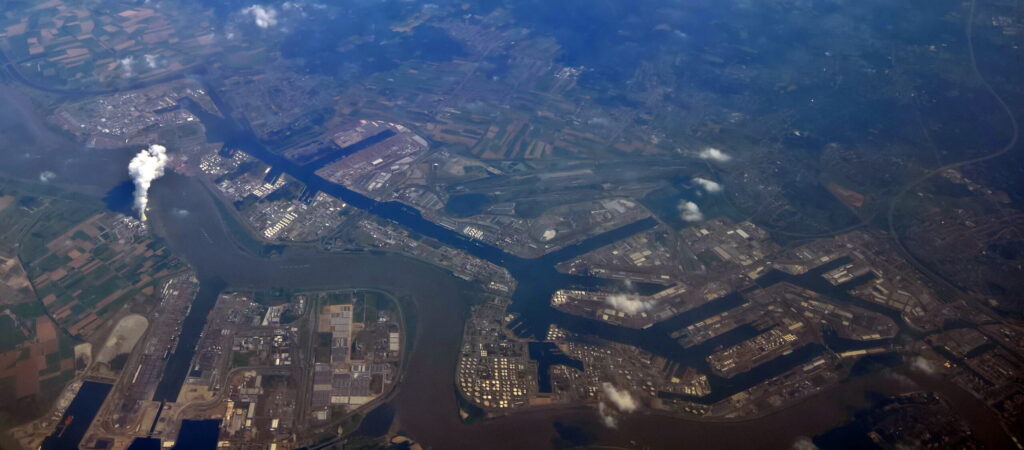
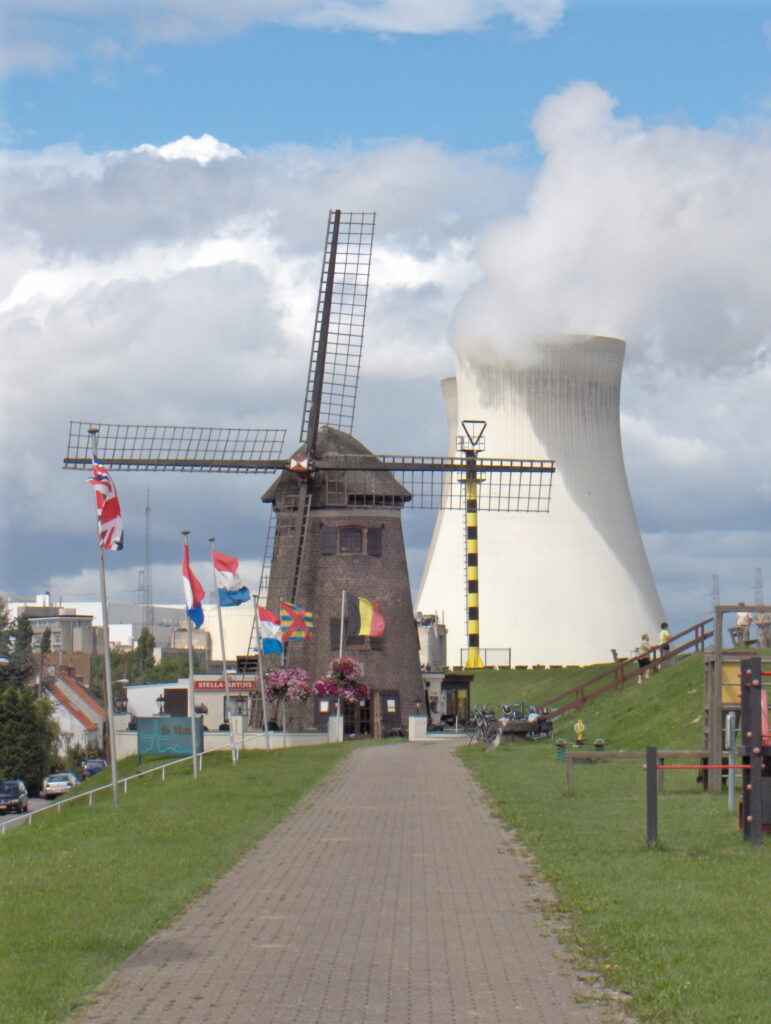
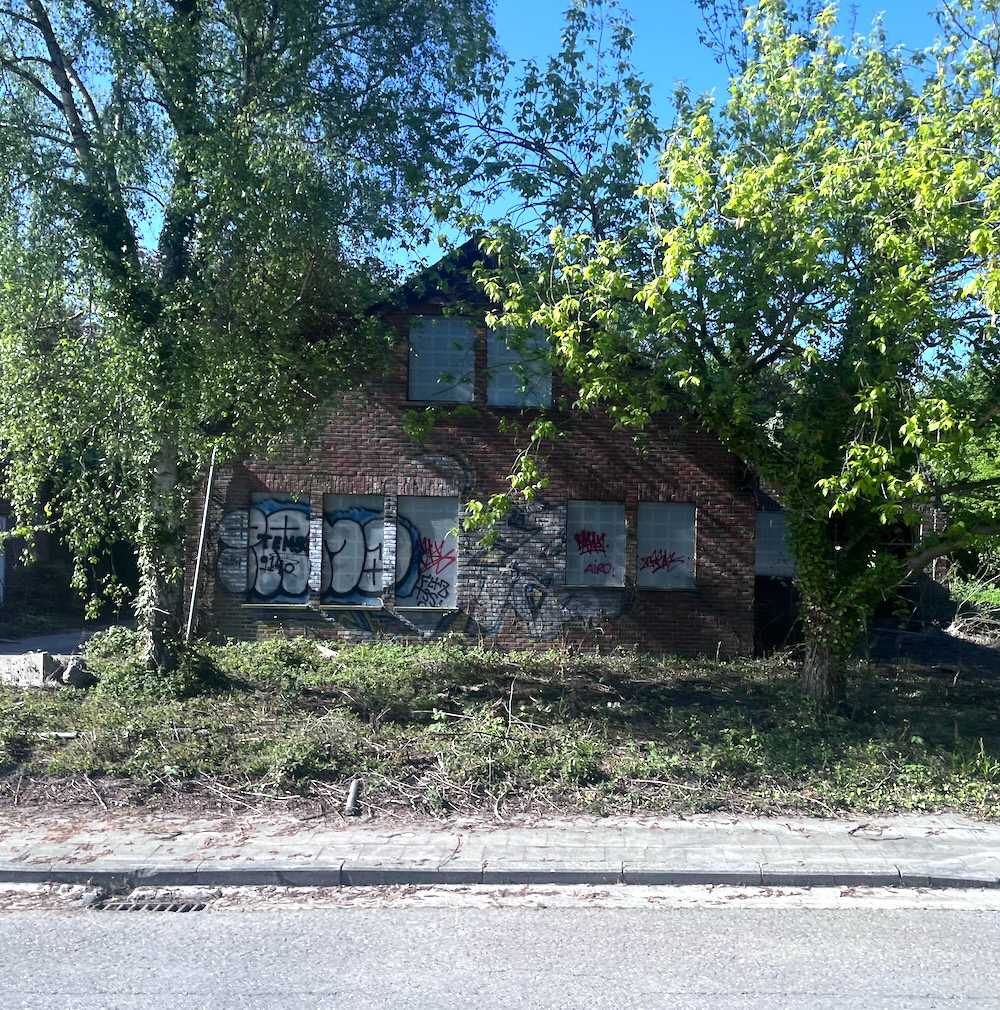
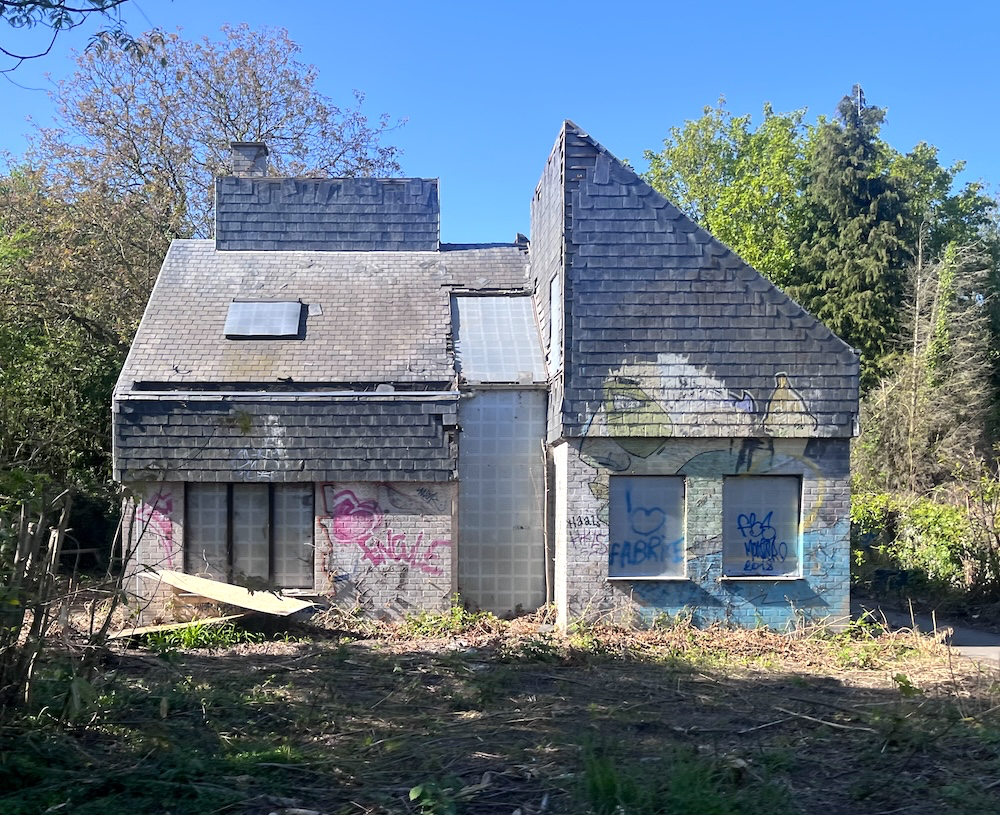
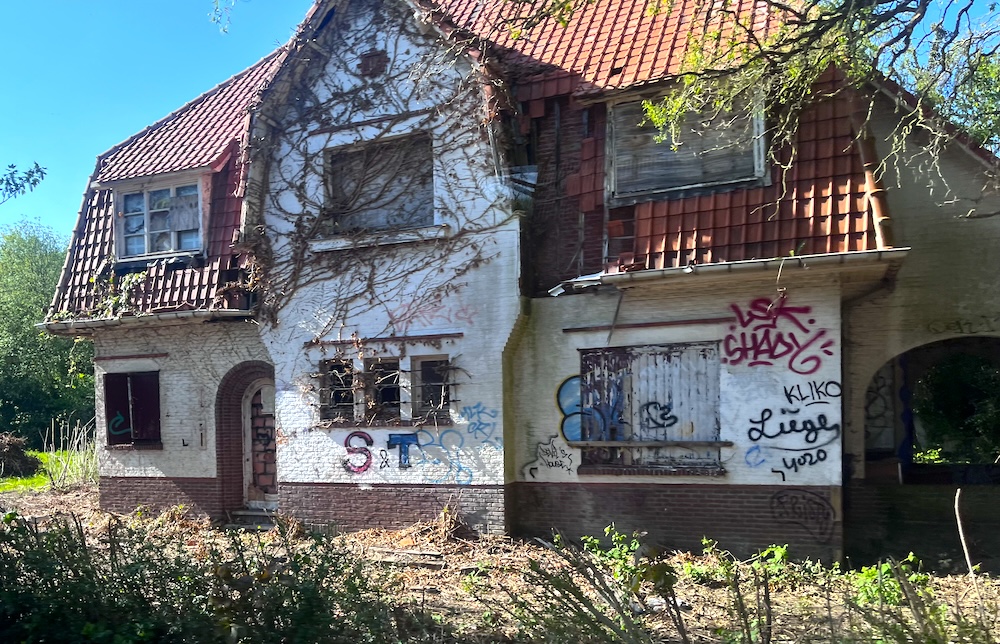
In 2024, fewer than 20 people were registered in Doel, a village on the left bank of the Scheldt some 20 kilometers downstream from Antwerp, Belgium. Street art covers crumbling facades, historic buildings stand alongside apparently abandoned houses, and the village church still anchors the center. On the dyke, a windmill dating back to 1614 overlooks the landscape, while two nuclear cooling towers dominate the horizon. Just beyond the last houses, the Port of Antwerp-Bruges begins. This post argues that Doel is not a ruin left behind by time. It is a village deliberately unmade that is now cautiously and unevenly trying to remake itself.
In April 2026, participants in the ContainerHavens workshop Contestation and Resistance in Ports visited Doel on a guided field visit led by Koen Wauman and Kevin de Mey, longtime members of citizen collective Doel 2020. For years, both have watched the village shrink, empty, and now begin a slow and partial recovery. Walking past boarded-up houses and empty plots where homes once stood, Koen recounted: “I think Doel is a very, very good example of how we shouldn’t do it in the future. We’re trying to correct this now, but a lot of time and energy has been wasted, and a lot of community has been wasted.”
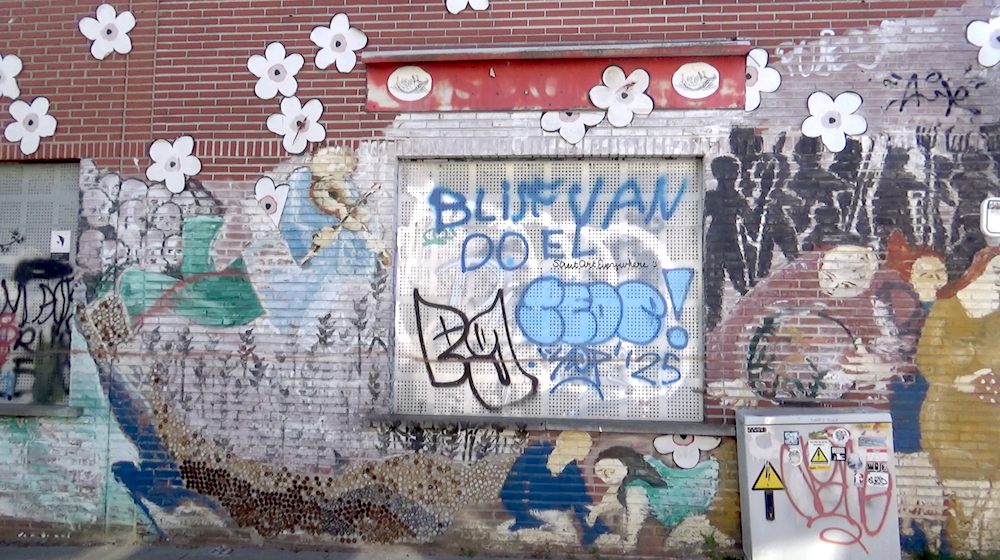
The story of Doel opens onto a broader question at the center of the FWO ContainerHavens project: how do legal and administrative procedures become arenas through which communities negotiate collective futures in port regions? As Doel illustrates, these processes are not only about contesting development. They also become spaces where local residents articulate and negotiate their visions for the future of their territory and its communities.
A village older than the port
Doel’s history stretches back to the thirteenth century. Its distinctive draughtboard street plan, established with the 1614 polder reclamation, remains largely unchanged today. The village is also home to the oldest brick-built windmill in Belgium, while the Inventory of Architectural Heritage of East Flanders lists 65 heritage buildings throughout the village. Over the years, residents and their lawyers repeatedly relied on this heritage in court, turning the village’s history into a powerful argument against its demolition.
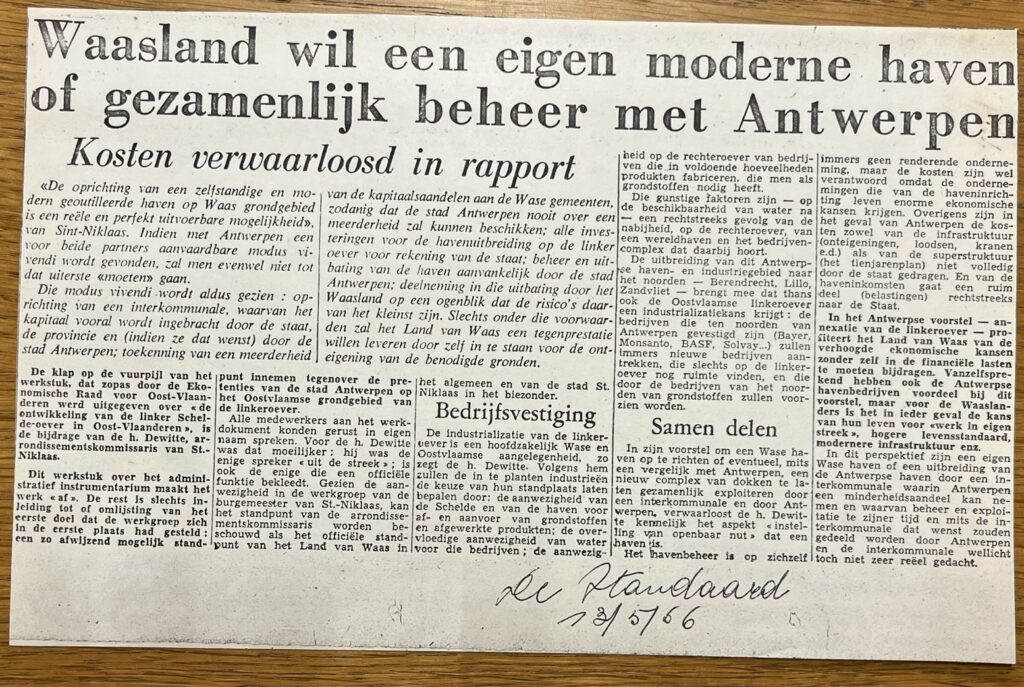
As early as 1966, the Economic Council of East Flanders identified Doel as a strategic area for port expansion on the Left Bank. In the years that followed, authorities imposed a building freeze that prohibited new housing construction. Young people and newly formed households could no longer build or find homes in Doel and were increasingly forced to settle elsewhere, fundamentally altering the village’s social fabric. Throughout the late 1970s, local residents, action groups, and supportive politicians successfully delayed expansion plans, and the economic slowdown after the oil crises of the 1970s and 1980s postponed them further. Long before demolition became a reality, the future of Doel had become the object of political negotiation and contestation.
How a village is emptied
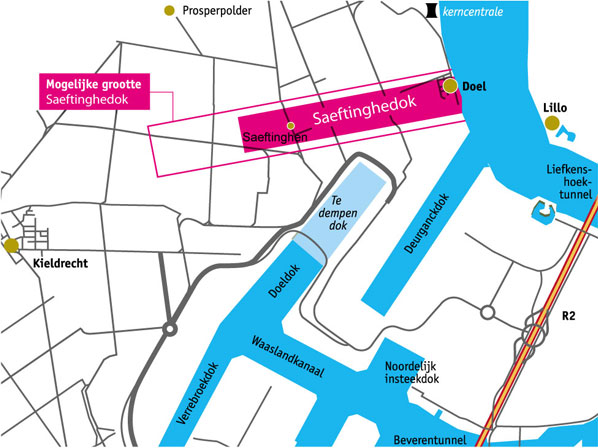
The decisive turning point came in 1997, when the Spatial Structure Plan for Flanders designated the entire Left Bank, where Doel stands, for port development. The plan paved the way for the construction of the Deurganckdok and the proposed Saeftinghedok, which would have erased Doel altogether.
As one resident described, a semi-public company began purchasing homes, offering financial compensation to those willing to leave. In a village where everyone knew each other, these buyouts gradually divided neighbors and families as people made different decisions about staying or leaving. Local shops, cafés, and the gas station eventually closed. The company refused to rent out the houses it had bought, leaving them to deteriorate. Basic services, including water, mail delivery, and a limited bus connection, continued. But the village itself was steadily hollowed out.
The same year, Doel 2020 was founded as a residents’ association and action committee. Its name reflected a simple but determined ambition: Doel would still exist in the year 2020. Bringing together residents, lawyers, researchers, and supporters across generations, the organization challenged expropriation orders, contested planning decisions, and sought emergency injunctions through the courts.
Winning in court, paying in concrete
The legal struggle over Doel ultimately unfolded through European environmental law. The Scheldt estuary had been designated as both a Special Protection Area under the Birds Directive and a Special Area of Conservation under the Habitats Directive, making it part of the Natura 2000 network. Under the Habitats Directive, any project likely to affect a protected site must undergo a rigorous appropriate assessment before it can be authorised.
The decisive legal battle concerned the proposed Saeftinghedok, a new tidal dock that, as mentioned, would have erased Doel entirely. Residents and environmental organizations challenged the Regional Spatial Implementation Plan (GRUP) that provided its planning basis. In 2013, the Council of State suspended the plan, ruling that the Flemish government had failed to guarantee that ecological compensation would be in place before protected habitats were destroyed. A revised plan adopted in 2014 was suspended again in 2015, and the Council referred the case to the Court of Justice of the European Union.
In its 2016 judgment in Orleans and Others v. Vlaams Gewest, the Court clarified that ecological compensation measures could not be taken into account unless they had already been implemented and their effectiveness had been demonstrated. The Flemish government’s argument that newly created nature could compensate in advance for habitats about to be destroyed was therefore incompatible with the Habitats Directive. The Council of State then annulled the planning framework for the Saeftinghedok in 2016 and again in 2017, removing the legal basis for the project.
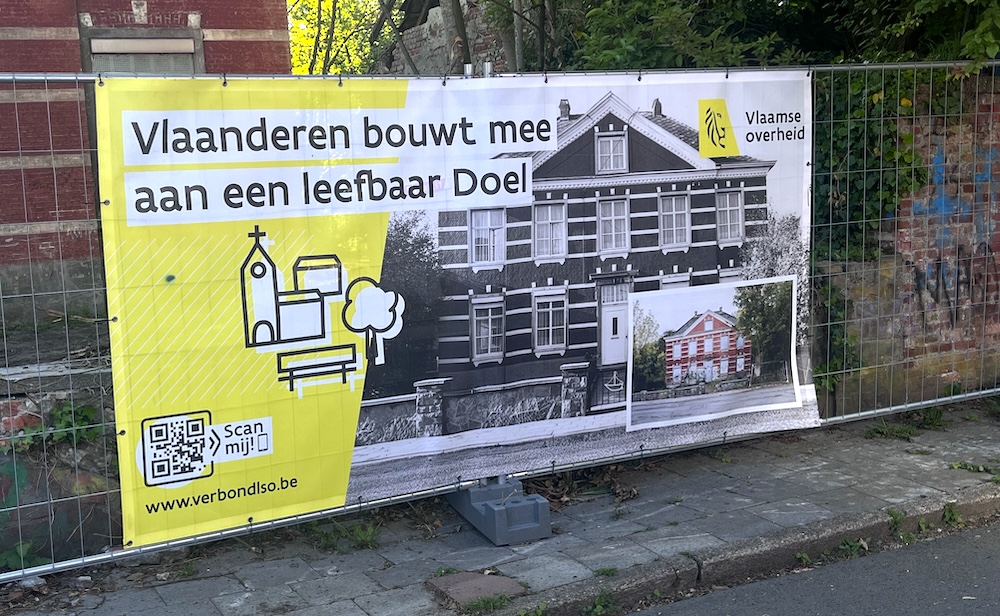
The litigation, however, did more than halt construction. It created the conditions for a new phase of negotiation. Between 2017 and 2022, 13 parties, including residents’ organizations, environmental groups, farming associations, heritage organizations, the Port Authority, and the Flemish government, negotiated the future of the Left Bank under the guidance of an independent mediator. The agreement reached in March 2022, the Ommelandverbond Linkerscheldeoever, allowed a new tidal dock to proceed while confirming Doel’s residential designation, committing to investment in housing, heritage, and recreation, redistributing agricultural land between farming and nature conservation, and establishing buffer zones between port activities and surrounding communities.
What compensation compensates
Nonetheless, the environmental arguments that helped preserve Doel were not without tension. As noted in a Doel 2020 blog post, drawing on the reflections of Chris De Stoop, people were displaced not only by port expansion but also by ecological compensation measures. The same concern emerged during interviews conducted as part of the ContainerHavens project. One interviewee reflected that financial incentives encouraged landowners to sell fields that would later be excavated and flooded as ecological compensation. These newly engineered wetlands, they argued, bore little relationship to the ecological dynamics of the polder or to the knowledge and livelihoods of the farming communities that had shaped the landscape for generations.
These experiences echo the findings of a recent study by Schmutzler, Katsigianni, and Van den Broeck, who argue that Natura 2000 protections became part of a broader territorial reconfiguration on the Left Bank. Environmental conservation, while intended to protect biodiversity, was experienced by many local actors as a form of “green dispossession,” in which ecological objectives reinforced existing patterns of land appropriation.
The Doel case illustrates that environmental legislation and social justice do not always align. The legal framework that helped preserve Doel also shifted the social and territorial costs of environmental protection onto residents and farming communities, while the industries and port operators responsible for the ecological damage did not bear those same costs. The conflict between industrial expansion, ecological compensation, and agricultural livelihoods was not resolved. It was redistributed.
Rebuilding beside a growing port
The story of Doel is still unfolding. In May 2026, the Flemish Government approved the draft project decision for the Containercluster Linkerscheldeoever, the operational core of the Extra Container Capacity Antwerp (ECA) project, centered on a second tidal dock adjacent to the Deurganckdok. If realized, the project would add capacity for approximately 7 million additional containers each year. At the time of writing, the proposal is open to public consultation until August 2026.
Looking ahead, Koen was candid about what comes next. The realization of the new dock has already been pushed back from 2030 to around 2040 or 2042. “It all depends on what engineering people find in the soil,” he remarked. The observation carries more weight than it first appears. Across the Scheldt, soil investigations for the Oosterweel project revealed PFAS contamination originating from 3M’s chemical plant, contamination that had gone undetected for decades.
The same institutions that once oversaw Doel’s decline are now leading its recovery. Retrocession rights, allowing former owners to reclaim properties no longer needed for port development, are only now being activated, more than 20 years after many residents were forced to leave. The courts ultimately secured Doel’s legal future, but they could not reverse the consequences of decades of uncertainty. By then, homes had disappeared, families had dispersed, and much of the village’s social fabric had unraveled. Saving Doel was one achievement; rebuilding its community is another.
Doel is not an isolated case. From San Pedro Bay to Tanger Med, port expansion keeps redrawing the ground under the communities that live beside it, displacing some and encircling others. This brings us back to the question that opened this piece: how do legal and administrative procedures become arenas through which communities negotiate collective futures in port regions? As Doel demonstrates, these arenas do more than mediate conflicts over port expansion. They also become spaces where residents continually articulate and negotiate their visions for the future of their territory and its communities.
As Koen reflected, “History shows that it’s never enough, and the harbour needs to grow, and ships become bigger.” He continued, “There is an economic law that says that you have to make growth possible. So that’s always a negative point for people living in and around that port.”
Whether established as a legal requirement, an economic principle, or a widely held assumption, the expectation that ports must continue to grow sets out the terms of every negotiation that follows. This is the question the ContainerHavens project pursues: How does the embedded logic of continuous growth determine not only the distribution of benefits and burdens but also which futures remain imaginable for the communities that live in and around ports?
Learn more
- Research site overview: Antwerp-Bruges Port
- Blog post: The automated port: Efficiency for whom?
- Blog post: The port is everywhere, but nowhere in court: PFAS, Antwerp, and the question of accountability
- Follow ContainerHavens on LinkedIn for further updates
About the author

Adriane Takahara Montenegro
Adriane Takahara Montenegro is a PhD candidate in Law at the University of Antwerp (Belgium). She holds a Bachelor of Laws (LL.B.) from the University of São Paulo (2019) and an Erasmus Mundus Master’s degree in Latin America and Europe in a Global World (2022). As part of the FWO ContainerHaven project, her doctoral research adopts a comparative perspective to examine how legal frameworks governing port operations and logistics infrastructures shape social, territorial, and ecological impacts on communities and everyday life. Her research is based on case studies in Antwerp, Tangier, and Cartagena and employs a socio-legal and ethnographic approach.
University of Antwerp
Faculty of Law and Institute of Development Policy (IOB)
Stadscampus – Gebouw V
Venusstraat 23
2000 Antwerp, Belgium
Research sites
Follow us
ContainerHavens 2026 | Disclaimer | Privacy policy | Cookie policy