
Research site
Port of Tanger Med
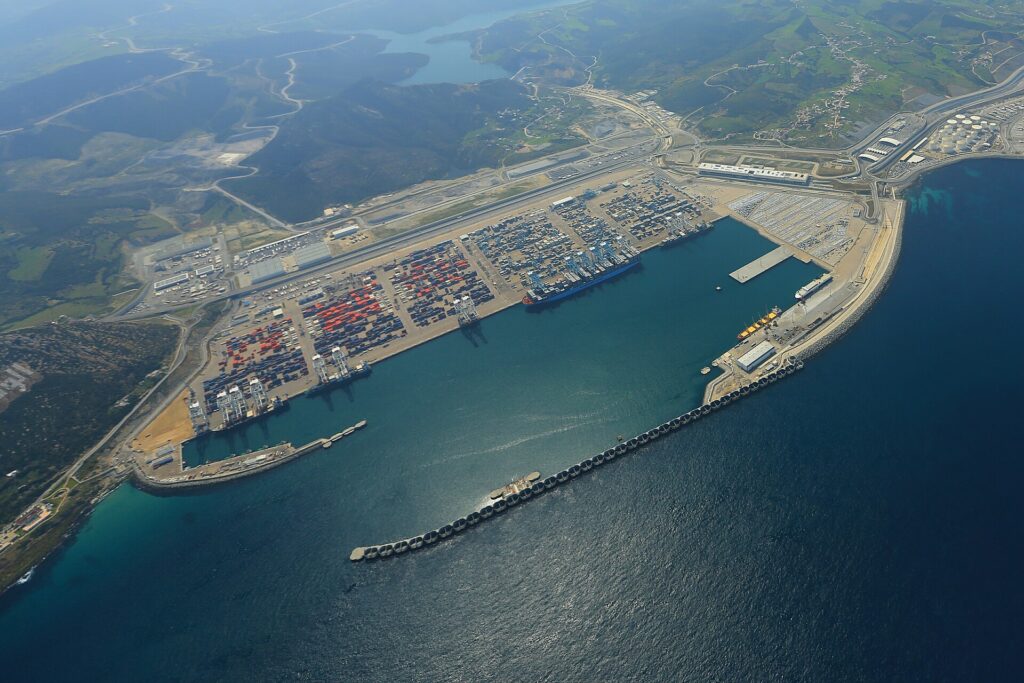
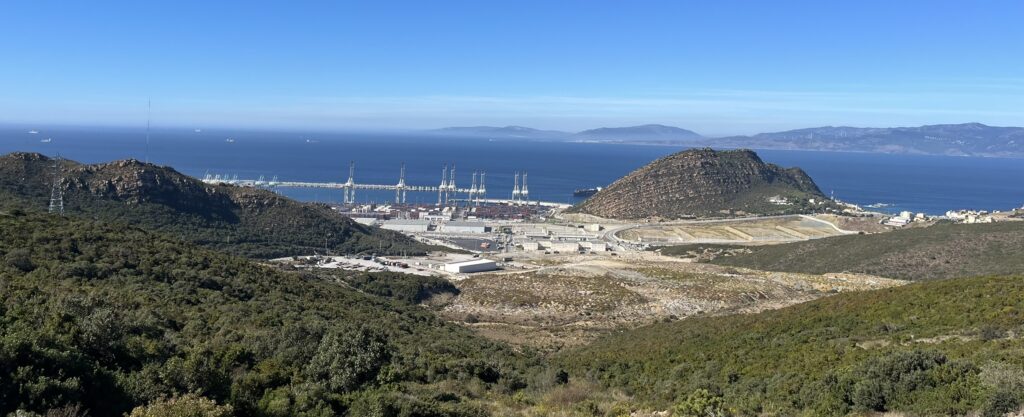
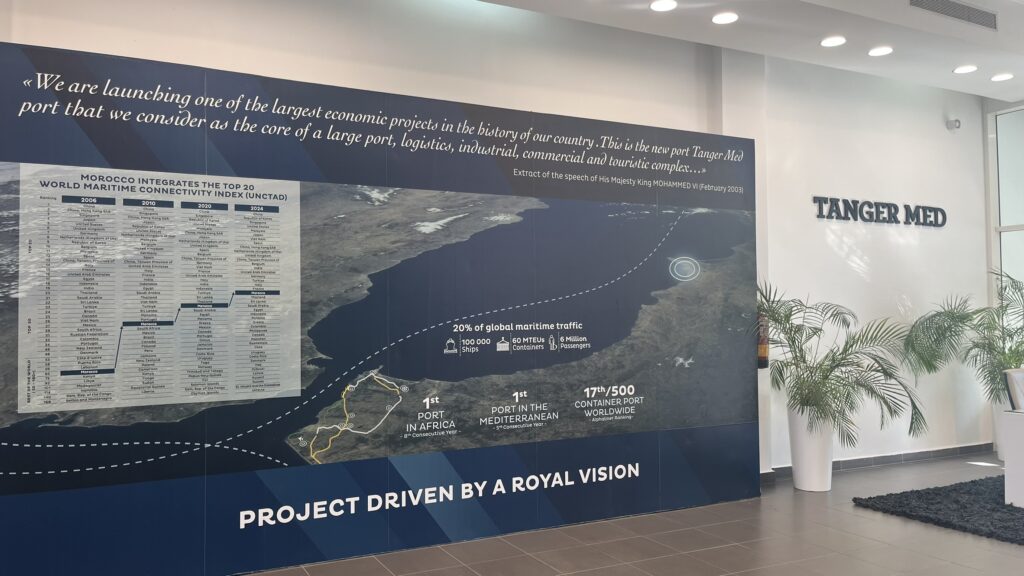
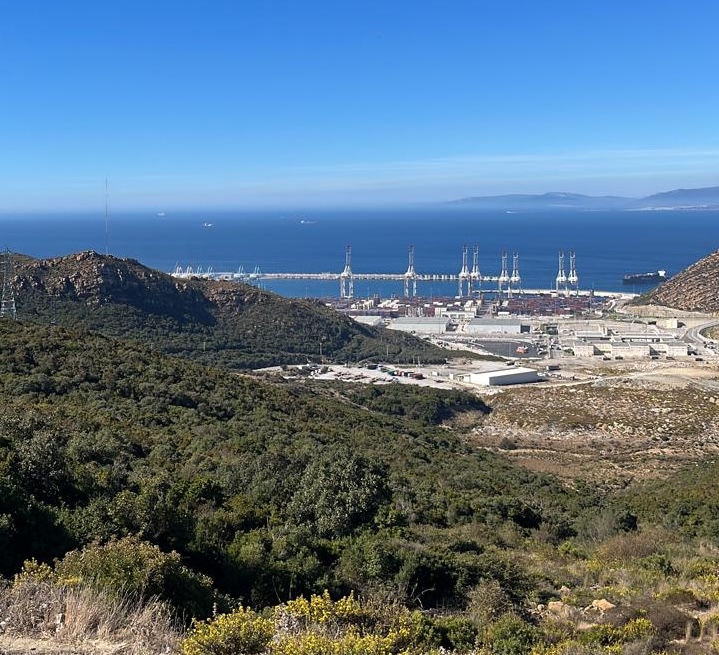
Tanger Med is Africa’s largest port and the leading container hub in the Mediterranean, a rank it has held through a pattern of continuous, state-driven expansion since the complex first opened in 2007. Positioned in the Strait of Gibraltar, at the western gateway of the Mediterranean, the port anchors one of Morocco’s most ambitious state development projects, launched by royal initiative in 2003 to link Europe, Africa, and global trade routes through a single integrated port, logistics, and industrial platform with direct connections to more than 180 ports in 70 countries.
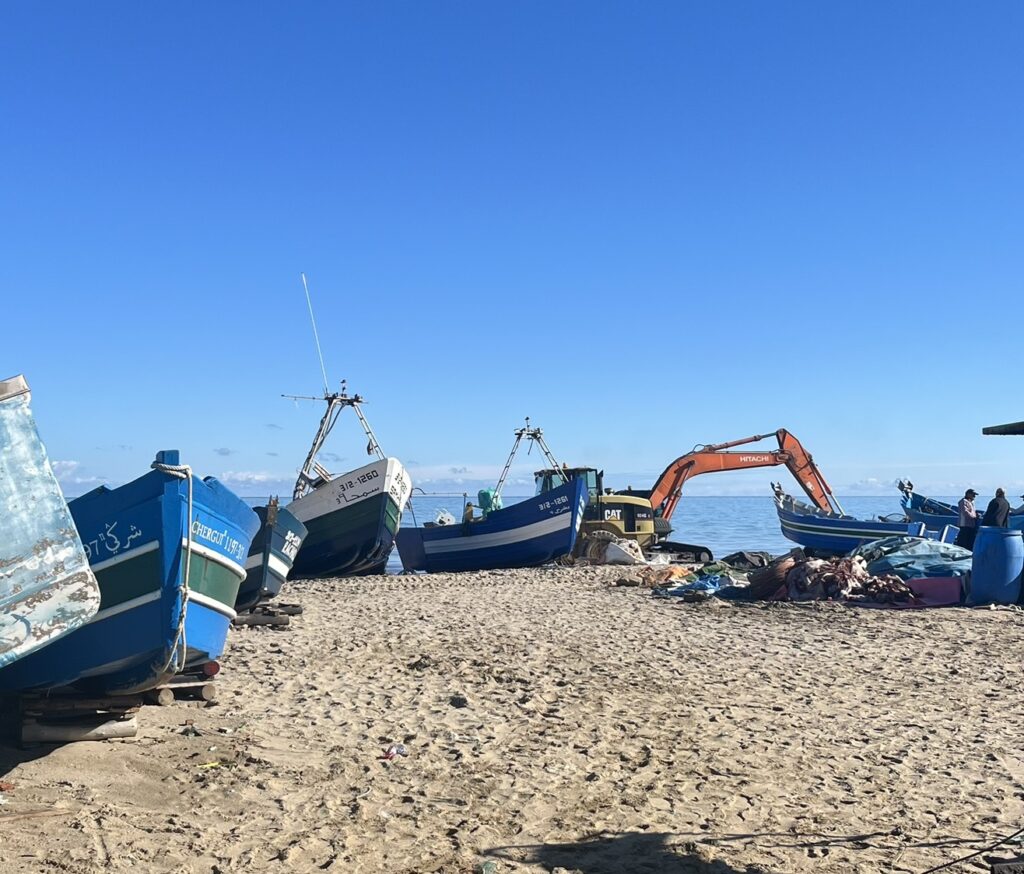
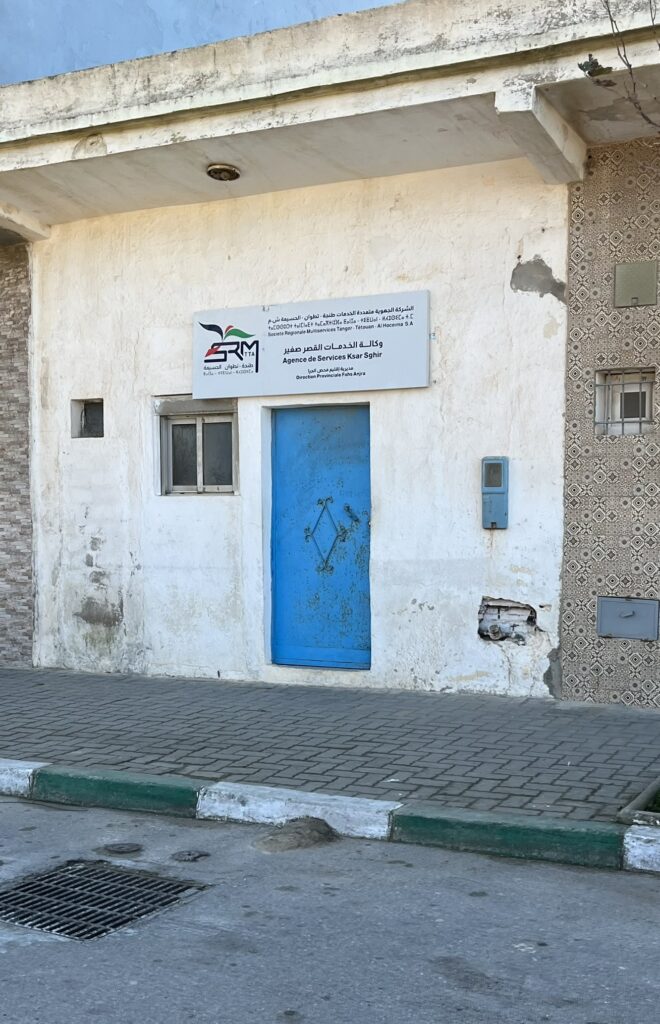
Despite its name, the port complex is not in the city of Tangier itself but about 40 kilometers to the northeast, within Fahs Anjra province, near the small town of Ksar es-Seghir. Its significance is also social: the port and its surrounding free zones are presented by the Moroccan government and the TMSA as an engine of a modern, industrializing Morocco, a narrative that sits in tension with the peripheral position experienced and shared by the rural and fishing communities in its immediate surroundings.
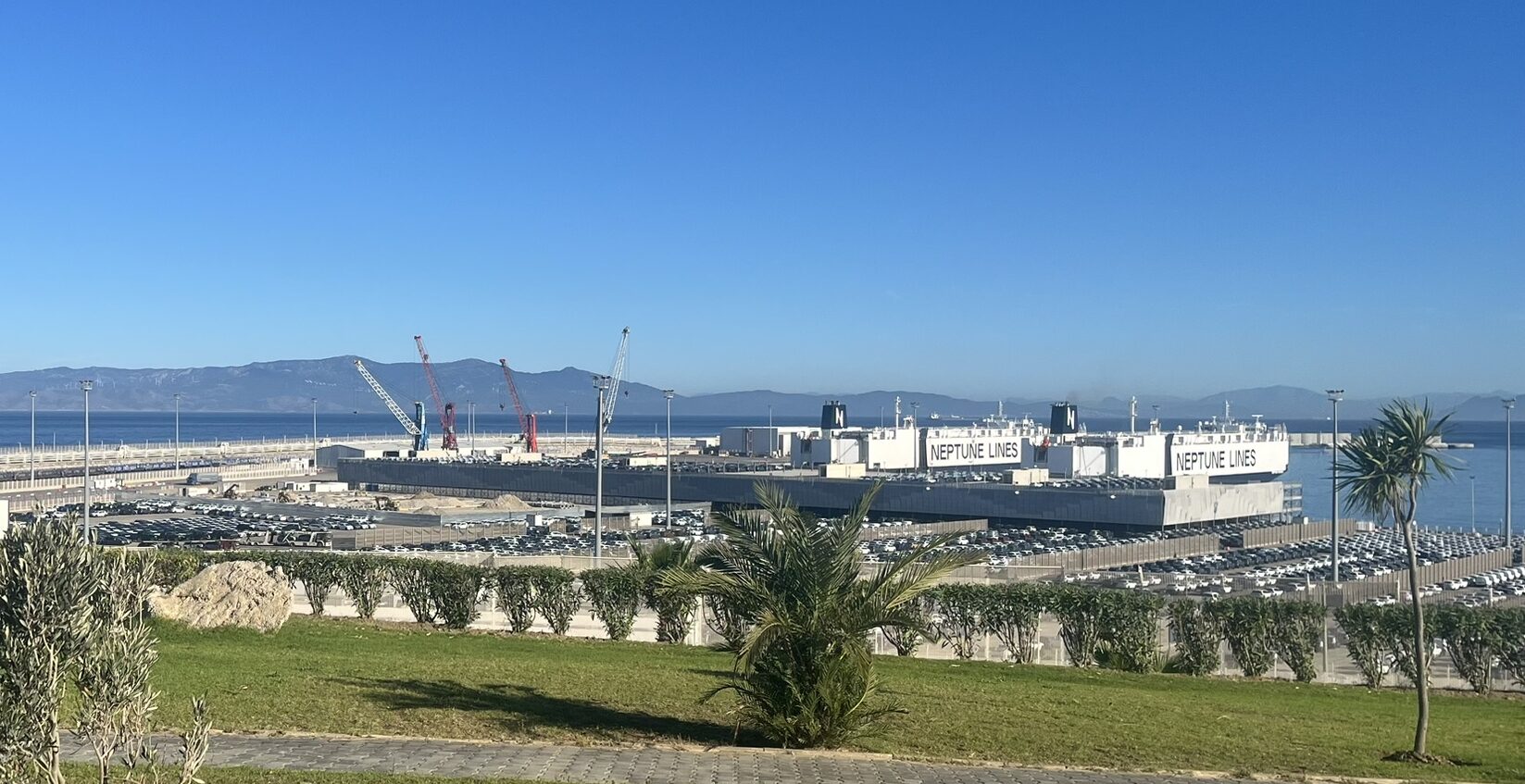
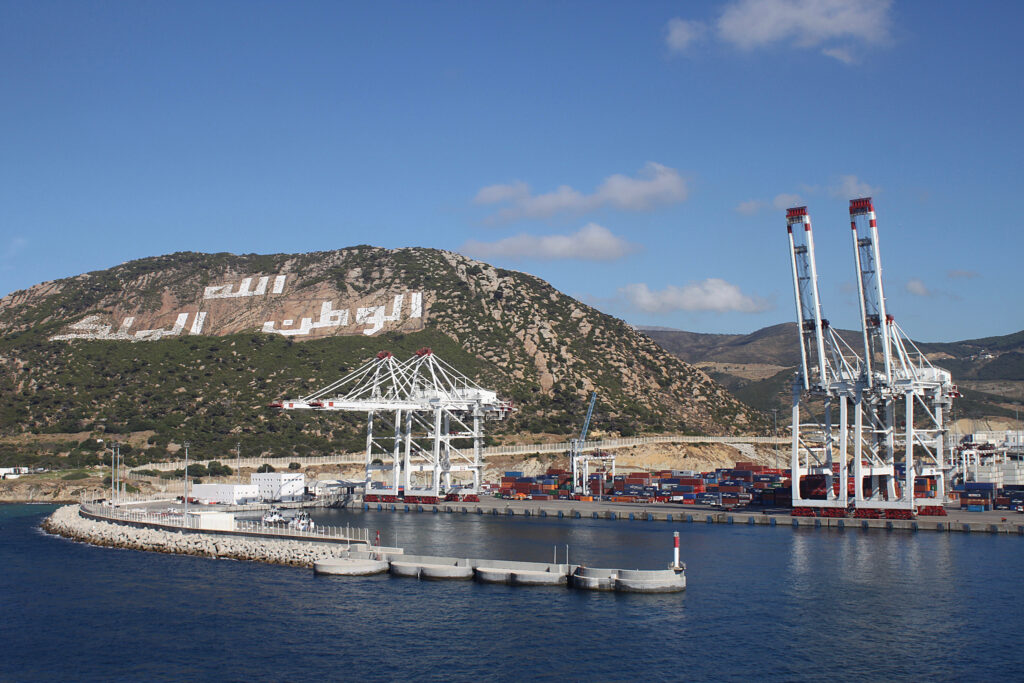
The port complex spans roughly one thousand hectares across three linked ports: container, vehicle, and hydrocarbon terminals, as well as a passenger crossing to Spain. That expansion has consistently outpaced the infrastructure built for it, as the complex has a nominal capacity of 9 million TEUs. In 2024, it handled 10.24 million TEUs and generated about USD 1.2 billion in revenue. Around it, the Tanger Med Zones industrial platform hosts more than 1,300 companies across automotive, aerospace, textile, and logistics, anchored by Renault’s plant at Melloussa and Stellantis’s facility in Kenitra, both of which ship finished vehicles out through the port itself.
That image of uninterrupted, state-backed growth sits alongside a different set of dynamics. Field observation around the port found a stark socio-spatial split: while Tanger Med and its industrial zones generate substantial regional and national revenue, the villages and municipalities bordering them see comparatively little of it, as reported by civil society and local authorities, with Corporate Social Responsibility (CSR) initiatives being limited by Tanger Med Foundation initiatives.
Agricultural communities often lack the technical qualifications required for port-related employment, and the work available to them tends to be subcontracted or low-skilled; municipalities report receiving no tax revenue or direct infrastructure investment from the port itself. Environmental oversight compounds this asymmetry. Morocco’s environmental impact law, Loi 12-03, channels every major project toward a single “environmental acceptability” decision, issued after a public inquiry; once granted, that acceptability decision is not revisited, meaning the initial approval window is effectively the only point at which a project can be meaningfully contested.
The automotive industry, not the port
Fieldwork carried out for this case study between October 2025 and January 2026 by ContainerHavens PhD researcher Adriane Takahara Montenegro, drawing on interviews with 24 public, private, and civil society actors alongside participant observation in Tangier and the villages surrounding the port, provides in-loco context to these dynamics. A recurring finding was that many interviewees pointed to the automotive industry, rather than the port or the Free Zones, as the more visible and locally significant force reshaping the region: it is Renault and Stellantis, not Tanger Med, dominated how interviewees described the area’s economic transformation. In Tangier city itself, Tanger Med’s rise made possible a second transformation.
With commercial shipping now concentrated at the new port, Tangier’s own historic port, which had operated under an exclusive concession granted by decree in 1921, was freed up for a royally initiated reconversion into Tanja Marina Bay, now the country’s first urban marina, and the wider Tanja Waterfront development. Although relocating port activities reduced some of the negative effects associated with the “old” port, including pollution and barriers to accessing the waterfront, it also created new spatial divisions. These projects have boosted tourism and luxury development which reshaped the relationship between the port city and the wider metropolitan region, contributed to gentrification in surrounding areas, and deepened inequalities between urban centers and peripheral communities.
Around the port itself, communities described a physical and administrative separation from Tanger Med’s operations, a sense reinforced by the port’s tightly controlled infrastructure, which connects its own industrial nodes internally while restricting public access. The result, as described in the fieldwork, is a broadly shared perception of Tanger Med as a detached entity within its own territory, generative for the region’s statistics but not for the communities living alongside it. Several interviewees framed these changes in terms that extended beyond economics alone, although their perspectives differed. Some welcomed the shift toward industrial employment as a sign of progress in northern Morocco. Others saw industrialization/modernization as gradually displacing a rural and agricultural way of life that predates the port by generations.
What are the Tanger Med Free Zones?
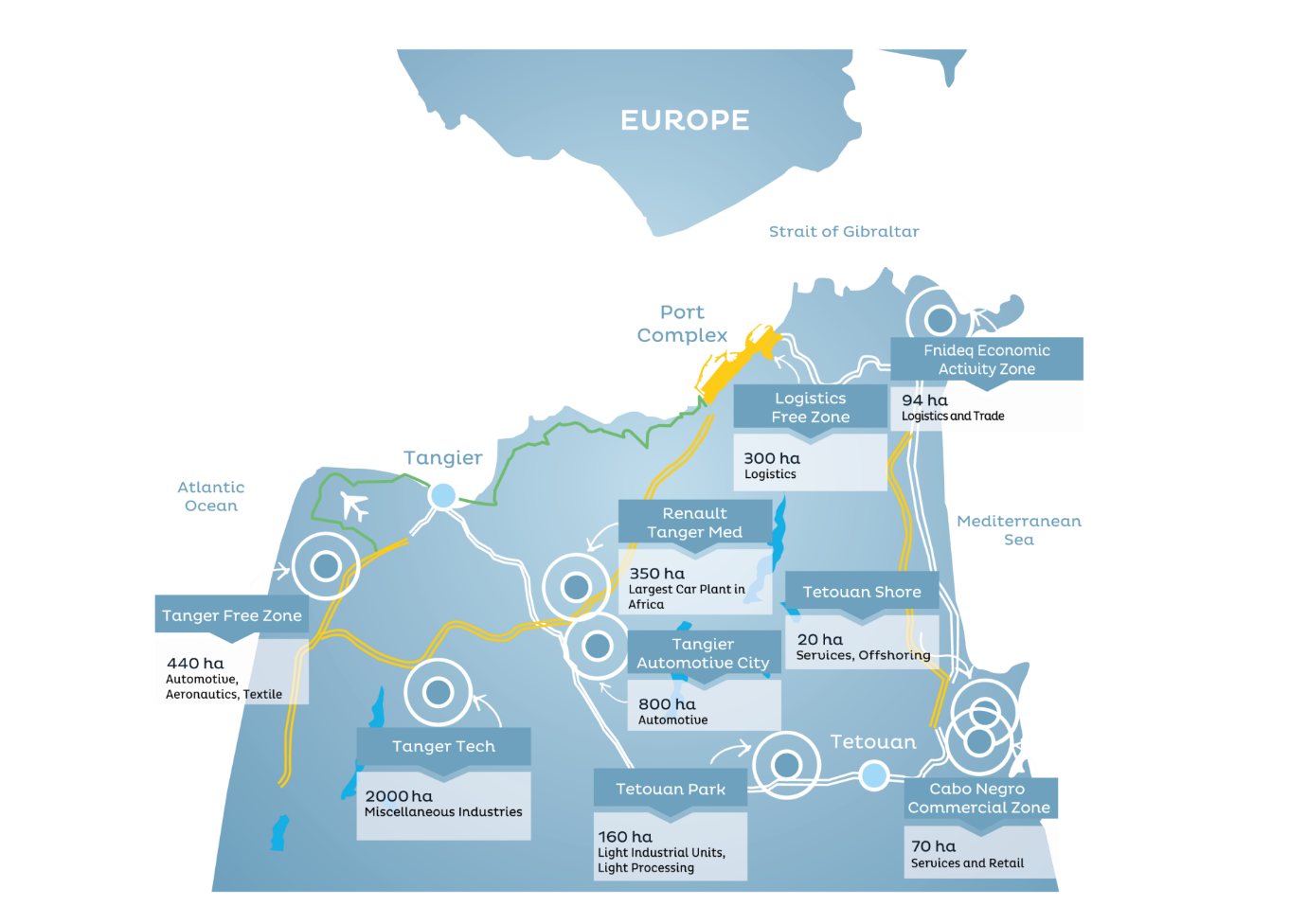
The Tanger Med Free Zones are a cluster of industrial and logistics parks built around the port, including the Tanger Free Zone (the first to open, in 1999) and Tanger Automotive City. Companies based there, mostly in automotive, aerospace, textiles, and logistics, benefit from tax exemptions and simplified customs procedures in exchange for exporting most of what they produce. The zones are what has drawn manufacturers like Renault and Stellantis to the region, and are managed, like the port itself, by TMSA.
A centralized governance model
Where Cartagena’s port governance is fragmented across a dozen or so separate institutions, Tanger Med runs on the opposite model: concentration. The Tanger Med Special Agency (TMSA) was created in 2002 by royal decree-law to develop and manage the special zone, and amended in 2006 to extend its authority beyond the zone’s original boundaries into the surrounding territory. TMSA is not simply a regulator, it also develops infrastructure, holds public authority prerogatives over land use and policing within its territory, and, through subsidiaries created in a 2011 restructuring, directly operates the port (Tanger Med Port Authority) and the free zones (Tanger Free Zone) it also oversees. Its ownership structure reflects its origins as a royal initiative more than an ordinary state enterprise: 87.5% of its capital is held by the Hassan II Fund for Economic and Social Development, a public development fund, with the remainder split between the state and the Caisse de Dépôt et de Gestion, Morocco’s state-owned financial institution.
That institutional concentration produces its own asymmetries. According to the fieldwork, TMSA’s regulatory flexibility is not evenly distributed: multinational corporations reportedly benefit from exceptions in production certification, allowing some imported goods to carry a “Made in Morocco” label, an exception to the standard requirements for local production, while domestic small and medium enterprises face comparatively rigid constraints in accessing the same agency.
What is TMSA?
The Tanger Med Special Agency (TMSA) is the public entity that plans, develops, and governs the Tanger Med port complex and its surrounding free zones. Created by royal decree-law in 2002 and majority-owned through the Hassan II Fund for Economic and Social Development, TMSA combines roles that are usually kept separate elsewhere: regulator, developer, and, through its subsidiaries, operator of the port and the free zones around it. Since a 2006 amendment, its authority also extends into the territory adjacent to the special zone itself.
Civil society mobilization around the port faces a different kind of constraint. No openly identified protest movement against the port’s expansion was observed during the fieldwork, and while concerns about expropriation procedures were acknowledged by local actors, they proved difficult to trace publicly. Interviewees widely described the project as a royal initiative, with key decisions made in the capital, Rabat, and regional actors left to implement centrally designed plans rather than shape them. Several interviewees raised, unprompted, a longer history of centre-periphery relations: a sense that North Morocco is regarded as slower-paced and less productive than Rabat, and that this colours how the region’s concerns are received.
The concentration documented on paper and the deference described in the interviews point to the same structure from two directions. An agency built to override the fragmentation and delay of ordinary administrative process, and empowered to reach beyond its own boundaries, leaves local and regional actors with no independent institution to appeal to when they experience its effects unevenly. That absence of an alternative address, formal and felt, is what the fieldwork consistently returned to.
The picture that emerges is of a port whose growth is inseparable from the concentrated, state-backed authority that built it, and whose costs and benefits are correspondingly concentrated too. At Tanger Med, ContainerHavens examines how a single, quasi-autonomous agency exercises authority beyond the port’s boundaries—and how this arrangement shapes who can claim a voice or share in the port economy and who must manage the local consequences of decisions taken elsewhere.
About this research
This page draws on Adriane Takahara Montenegro’s fieldwork in Tangier. If any of this connects with what you’re working on, we’d be glad to hear from you.
Tanger Med is Africa’s largest port and the leading container hub in the Mediterranean, a rank it has held through a pattern of continuous, state-driven expansion since the complex first opened in 2007. Positioned in the Strait of Gibraltar, at the western gateway of the Mediterranean, the port anchors one of Morocco’s most ambitious state development projects, launched by royal initiative in 2003 to link Europe, Africa, and global trade routes through a single integrated port, logistics, and industrial platform with direct connections to more than 180 ports in 70 countries.
Despite its name, the port complex is not in the city of Tangier itself but about 40 kilometers to the northeast, within Fahs Anjra province, near the small town of Ksar es-Seghir. Its significance is also social: the port and its surrounding free zones are presented by the Moroccan government and the TMSA as an engine of a modern, industrializing Morocco, a narrative that sits in tension with the peripheral position experienced and shared by the rural and fishing communities in its immediate surroundings.
The port complex spans roughly one thousand hectares across three linked ports: container, vehicle, and hydrocarbon terminals, as well as a passenger crossing to Spain. That expansion has consistently outpaced the infrastructure built for it, as the complex has a nominal capacity of 9 million TEUs. In 2024, it handled 10.24 million TEUs and generated about USD 1.2 billion in revenue. Around it, the Tanger Med Zones industrial platform hosts more than 1,300 companies across automotive, aerospace, textile, and logistics, anchored by Renault’s plant at Melloussa and Stellantis’s facility in Kenitra, both of which ship finished vehicles out through the port itself.
That image of uninterrupted, state-backed growth sits alongside a different set of dynamics. Field observation around the port found a stark socio-spatial split: while Tanger Med and its industrial zones generate substantial regional and national revenue, the villages and municipalities bordering them see comparatively little of it, as reported by civil society and local authorities, with Corporate Social Responsibility (CSR) initiatives being limited by Tanger Med Foundation initiatives.
Agricultural communities often lack the technical qualifications required for port-related employment, and the work available to them tends to be subcontracted or low-skilled; municipalities report receiving no tax revenue or direct infrastructure investment from the port itself. Environmental oversight compounds this asymmetry. Morocco’s environmental impact law, Loi 12-03, channels every major project toward a single “environmental acceptability” decision, issued after a public inquiry; once granted, that acceptability decision is not revisited, meaning the initial approval window is effectively the only point at which a project can be meaningfully contested.
The automotive industry, not the port
Fieldwork carried out for this case study between October 2025 and January 2026 by ContainerHavens PhD researcher Adriane Takahara Montenegro, drawing on interviews with 24 public, private, and civil society actors alongside participant observation in Tangier and the villages surrounding the port, provides in-loco context to these dynamics. A recurring finding was that many interviewees pointed to the automotive industry, rather than the port or the Free Zones, as the more visible and locally significant force reshaping the region: it is Renault and Stellantis, not Tanger Med, dominated how interviewees described the area’s economic transformation. In Tangier city itself, Tanger Med’s rise made possible a second transformation.
With commercial shipping now concentrated at the new port, Tangier’s own historic port, which had operated under an exclusive concession granted by decree in 1921, was freed up for a royally initiated reconversion into Tanja Marina Bay, now the country’s first urban marina, and the wider Tanja Waterfront development. Although relocating port activities reduced some of the negative effects associated with the “old” port, including pollution and barriers to accessing the waterfront, it also created new spatial divisions. These projects have boosted tourism and luxury development which reshaped the relationship between the port city and the wider metropolitan region, contributed to gentrification in surrounding areas, and deepened inequalities between urban centers and peripheral communities.
Around the port itself, communities described a physical and administrative separation from Tanger Med’s operations, a sense reinforced by the port’s tightly controlled infrastructure, which connects its own industrial nodes internally while restricting public access. The result, as described in the fieldwork, is a broadly shared perception of Tanger Med as a detached entity within its own territory, generative for the region’s statistics but not for the communities living alongside it. Several interviewees framed these changes in terms that extended beyond economics alone, although their perspectives differed. Some welcomed the shift toward industrial employment as a sign of progress in northern Morocco. Others saw industrialization/modernization as gradually displacing a rural and agricultural way of life that predates the port by generations.
What are the Tanger Med Free Zones?
The Tanger Med Free Zones are a cluster of industrial and logistics parks built around the port, including the Tanger Free Zone (the first to open, in 1999) and Tanger Automotive City. Companies based there, mostly in automotive, aerospace, textiles, and logistics, benefit from tax exemptions and simplified customs procedures in exchange for exporting most of what they produce. The zones are what has drawn manufacturers like Renault and Stellantis to the region, and are managed, like the port itself, by TMSA.
A centralized governance model
Where Cartagena’s port governance is fragmented across a dozen or so separate institutions, Tanger Med runs on the opposite model: concentration. The Tanger Med Special Agency (TMSA) was created in 2002 by royal decree-law to develop and manage the special zone, and amended in 2006 to extend its authority beyond the zone’s original boundaries into the surrounding territory. TMSA is not simply a regulator, it also develops infrastructure, holds public authority prerogatives over land use and policing within its territory, and, through subsidiaries created in a 2011 restructuring, directly operates the port (Tanger Med Port Authority) and the free zones (Tanger Free Zone) it also oversees. Its ownership structure reflects its origins as a royal initiative more than an ordinary state enterprise: 87.5% of its capital is held by the Hassan II Fund for Economic and Social Development, a public development fund, with the remainder split between the state and the Caisse de Dépôt et de Gestion, Morocco’s state-owned financial institution.
That institutional concentration produces its own asymmetries. According to the fieldwork, TMSA’s regulatory flexibility is not evenly distributed: multinational corporations reportedly benefit from exceptions in production certification, allowing some imported goods to carry a “Made in Morocco” label, an exception to the standard requirements for local production, while domestic small and medium enterprises face comparatively rigid constraints in accessing the same agency.
What is TMSA?
The Tanger Med Special Agency (TMSA) is the public entity that plans, develops, and governs the Tanger Med port complex and its surrounding free zones. Created by royal decree-law in 2002 and majority-owned through the Hassan II Fund for Economic and Social Development, TMSA combines roles that are usually kept separate elsewhere: regulator, developer, and, through its subsidiaries, operator of the port and the free zones around it. Since a 2006 amendment, its authority also extends into the territory adjacent to the special zone itself.
Civil society mobilization around the port faces a different kind of constraint. No openly identified protest movement against the port’s expansion was observed during the fieldwork, and while concerns about expropriation procedures were acknowledged by local actors, they proved difficult to trace publicly. Interviewees widely described the project as a royal initiative, with key decisions made in the capital, Rabat, and regional actors left to implement centrally designed plans rather than shape them. Several interviewees raised, unprompted, a longer history of centre-periphery relations: a sense that North Morocco is regarded as slower-paced and less productive than Rabat, and that this colours how the region’s concerns are received.
The concentration documented on paper and the deference described in the interviews point to the same structure from two directions. An agency built to override the fragmentation and delay of ordinary administrative process, and empowered to reach beyond its own boundaries, leaves local and regional actors with no independent institution to appeal to when they experience its effects unevenly. That absence of an alternative address, formal and felt, is what the fieldwork consistently returned to.
The picture that emerges is of a port whose growth is inseparable from the concentrated, state-backed authority that built it, and whose costs and benefits are correspondingly concentrated too. At Tanger Med, ContainerHavens examines how a single, quasi-autonomous agency exercises authority beyond the port’s boundaries—and how this arrangement shapes who can claim a voice or share in the port economy and who must manage the local consequences of decisions taken elsewhere.At the same time, the port’s scale and industrial activities generate uneven social and environmental outcomes. While, according to the statistics of the Port Authority, it creates approximately 161,533 direct, indirect and induced employment opportunities for both Belgians and non-Belgian workers, the port operates as much more than a transport hub. There are large industrial, logistics, and petrochemical clusters where manufacturing, processing, and value addition activities take place alongside cargo handling. These diverse activities are structured through a highly segmented labour system. Registered and unionised dock workers and logistics contingent coexist across the port with more precarious, non-unionised, and outsourced forms of labour in the surrounding industries and warehouses who often lack formal recognition in port labour regimes yet remain essential for port operations. As a result, the official metrics used to celebrate the port’s regional economic contributions obscure the reality on the ground. By keeping other workers who are logistically, socially, and operationally integrated into port operations external from port labour regimes, institutional actors continue to claim high employment standards for formally recognised “port workers” while ignoring the systemic vulnerability of the peripheral and invisible workers who keep the logistics chain moving.
About this research
This page draws on Adriane Takahara Montenegro’s fieldwork in Tangier. If any of this connects with what you’re working on, we’d be glad to hear from you.
Latest updates on the Port of Tanger Med
Tanger Med, logistique globale et recompositions territoriales
This blog post is also available in English. Organisée le 13 janvier 2026 dans le…
Tanger Med, global logistics and territorial recompositions
Cet article est également disponible en français. Organised on 13 January 2026 as part of…
University of Antwerp
Faculty of Law and Institute of Development Policy (IOB)
Stadscampus – Gebouw V
Venusstraat 23
2000 Antwerp, Belgium
Research sites
Follow us
ContainerHavens 2026 | Disclaimer | Privacy policy | Cookie policy