
Cet article est également disponible en français.
Organised on 13 January 2026 as part of the Research Foundation Flanders – FWO ContainerHaven research project at the University of Antwerp, the study day entitled “Cross-perspectives on the port ecosystem of Tangier” — devoted to the Tanger Med ecosystem, hosted by Think Tanger and supported by Beyond Mobility — brought together researchers, practitioners and local actors around a shared objective: to analyse the territorial, social and environmental effects of global logistics, while ensuring that the knowledge produced could circulate beyond the academic world alone. The research project within which this event takes place places particular importance on the involvement of local actors and on the way fieldwork can, in time, benefit the territories studied and their communities. This report follows that same logic, offering an accessible and cross-cutting account of the main lessons of the day.
The following professors, post-doctoral researchers and doctoral candidates joined the conversation:
- Michel Peraldi / Emeritus Research Director / CNRS, IRIS-EHESS / Anthropologist
- Fatima Zahra Meskali / PhD Candidate / Moulay Ismail University / Architect / Anthropologist / Sociologist
- Emmanuelle Durand / Post-doctoral Researcher / IRIS-EHESS, Paris 1, CNAM / Anthropologist
- Omar Belkheiri / Professor / Abdelmalek Essaâdi University, ENCG / Economist
- Yolande Benarrosh / Emeritus Professor / Aix-Marseille University, UMR / Sociologist
- Ginevra Montefusco / PhD Student / University of Padua & Ca’ Foscari University of Venice / Geographer
- Adriane Takahara Montenegro / PhD Student / University of Antwerp, Faculty of Law / Legal scholar
Tanger Med, or the rise of a world-port
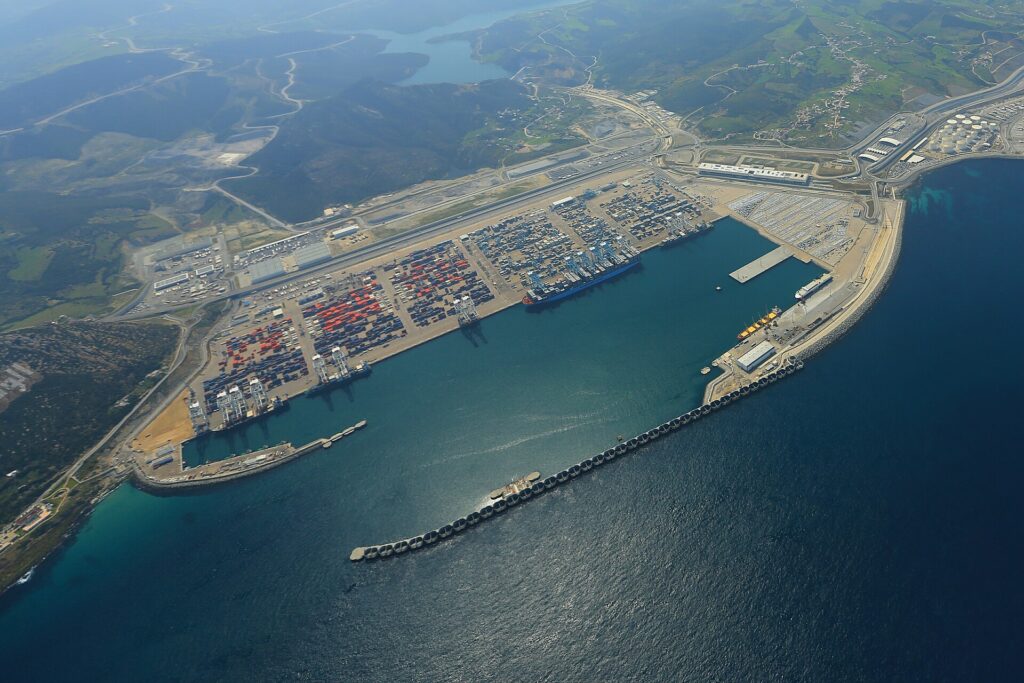
The trajectory of Tanger Med illustrates the growing place of logistics infrastructure in contemporary development strategies. Located in the immediate vicinity of the “motorway of the seas,” the port established itself in less than two decades as a central node of international maritime trade, rapidly overtaking historic Mediterranean ports. This rise rests on a close combination of geopolitical choices, massive investment and integration into global value chains.
The Moroccan state plays a structuring role here, both as institutional guarantor and as an economic actor capable of mobilising international networks and durably steering flows. Tanger Med thus appears as a revealing example of contemporary forms of logistics capitalism, in which infrastructure performance becomes a central lever of territorial competitiveness.
From the historic port to the port-machine
This dynamic is part of a long port history. Since the 17th century, Tangier has undergone several phases of development linked to its strategic position in the Strait of Gibraltar, to the involvement of foreign powers and to its status as an international city. The historic port, without occupying a dominant place in the Mediterranean basin, developed in close relationship with the city, offering a strong porosity between port, urban and social spaces. It was above all a setting for multiple activities, embedded in the urban fabric of Tangier.
The creation of Tanger Med in the early 2000s marks a major shift. Whereas the historic port existed in functional and spatial continuity with the city, Tanger Med introduces a profoundly different model: a secured, highly specialised infrastructure, oriented towards maximum container fluidity and largely autonomous with respect to its immediate environment. This reconfiguration raises questions about contemporary forms of port governance, but also about the capacity of territories to absorb rapid, large-scale transformations.

Tanger Med and Tangier: an expanded territorial ecosystem
Set at the regional scale, Tanger Med nonetheless retains a large degree of operational autonomy, illustrating a development pattern in which mega-projects evolve on a level parallel to that of the territories hosting them. The port relies on a specific governance structure, embodied notably by TMSA, which allows it to benefit from administrative and legal regimes suited to the demands of global logistics and favourable to the rapid development of its ecosystem. This relative independence does not, however, mean total disconnection. The port remains closely tied to Tangier through the free zones and industrial zones established in and around the city, which are fully part of the Tanger Med ecosystem. This connection also materialises through the drawing-in of a workforce largely originating from Tangier, generating multiple effects on the city, in terms of both daily mobility and social and economic dynamics.
Uneven territorial reconfigurations
At the regional scale, the effects of this dynamic appear highly contrasting. While some territories benefit from significant investment and direct integration into the logistics system, others follow more fragile or subordinate trajectories. Certain towns become spaces of labour, transit or industrial relegation, while others, historically structured by cross-border economies, are strongly destabilised by the reconfiguration of flows.
The situation of Fnideq particularly illustrates these tensions. Long an essential node of informal circulation, the town faces a rapid loss of activity linked to the progressive closure of the land borders and the concentration of flows towards Tanger Med. The reconversion policies implemented struggle to offset the loss of economic, social and symbolic resources, durably weakening forms of local identity rooted in circulation, trade and specific know-how. This situation invites us to question the ways in which logistics development and territorial heritage are articulated, rather than framing a head-on opposition between past and present.

Chrafate: industrial urbanisation and rural reconfigurations
The transformation of the Tangier territory is also expressed through the creation of the new town of Chrafate. Implemented within the framework of a special development zone led by TMSA, this operation was accompanied by profound land and territorial reconfigurations, affecting pre-existing villages and agricultural and coastal activities.
Urban infrastructure was rapidly put in place, but the pace at which new residents are settling remains limited. It is important, however, to distinguish between the reconfigurations that occurred in rural areas — marked by the loss of access to certain lands and resources — and the still-unfinished development of the new town itself. Chrafate thus highlights the gaps between planned urbanisation, transformations of the surrounding rural territories, and the social temporalities of dwelling.
Coastline, artisanal fishing and erased memories
Port and urban transformations also affect the coastline and the practices historically linked to it. Artisanal fishing, and in particular shore-based (on-foot) fishing, once structured close relationships between food, sociability and the marine environment. The concreting-over of the coastline, the securing of access points and certain environmental nuisances have progressively reduced the place of these practices.
The accounts gathered sketch a geography of memory made up of vanished beaches, quays that have become inaccessible, and erased places of conviviality. These “ghosts of the coastline” bear witness to a process by which local practices — yet central to food circuits, the transmission of ecological knowledge, and the link between residents and their environment — are rendered invisible.
Making logistics perceptible in another way
In the face of these transformations, the methodological approaches deployed occupy a central place. Urban walks, participatory mapping and research-creation practices make it possible to document the lived effects of global logistics, as close as possible to the territories concerned. The sound-based approach, in particular, offers a valuable tool for grasping the rhythms, the din and the silences produced by infrastructure.
These methodologies also give an important place to the voices and experiences of communities that are directly affected but often marginalised in decision-making processes. By creating spaces for expression and shared restitution, they help to shift the perspective and to enrich understanding of the social and environmental impacts of large-scale projects.
Continuing the conversation…
Rather than closing off reflection, this study day opens a space for continuation. The analyses, accounts and materials produced form a solid basis for imagining concrete follow-ups: workshops with local actors, public restitution sessions, decision-support mechanisms, or collaborative projects bringing together researchers, local authorities and residents, in a logic of co-creation of knowledge.
Learn more
- This article was originally published in French by Think Tanger at the following URL: https://www.linkedin.com/pulse/tanger-med-logistique-globale-et-recompositions-territoriales-e7che/
- Follow ContainerHavens on LinkedIn for further updates
- Follow Think Tanger on LinkedIn for futher updates
About the authors

Mouna Guidiri
Research assistantMouna Guidiri is a consultant based in Rabat, Morocco. She co-founded Beyond Mobility, a research and practice-based initiative providing training, research, and evaluation support to NGOs and social workers. She holds a Master’s degree in Development Evaluation from the University of Antwerp. Her research interests focus on the interactions between migration dynamics and (cheap) labour, as well as on the functioning of global circuits of capitalism and their local effects in terms of inclusion and exclusion.
As part of the FWO ContainerHavens Project, she supported the Tanger Med Port fieldwork by assisting with field activities and facilitating access to local actors. She also provided interpretation during interviews and contributed to the organization of workshops with university students and a closing seminar.

Adriane Takahara Montenegro
PhD candidateAdriane Takahara Montenegro is a PhD candidate in Law at the University of Antwerp (Belgium). She holds a Bachelor of Laws (LL.B.) from the University of São Paulo (2019) and an Erasmus Mundus Master’s degree in Latin America and Europe in a Global World (2022). As part of the FWO ContainerHaven project, her doctoral research adopts a comparative perspective to examine how legal frameworks governing port operations and logistics infrastructures shape social, territorial, and ecological impacts on communities and everyday life. Her research is based on case studies in Antwerp, Tangier, and Cartagena and employs a socio-legal and ethnographic approach.
University of Antwerp
Faculty of Law and Institute of Development Policy (IOB)
Stadscampus – Gebouw V
Venusstraat 23
2000 Antwerp, Belgium
Research sites
Follow us
ContainerHavens 2026 | Disclaimer | Privacy policy | Cookie policy