
When containerization emerged in the 1960s, the International Longshore and Warehouse Union (ILWU) faced a difficult choice on whether to resist or accept and shape its implementation.[1] Difficult because the introduction of containerization was characterized not only by questions about containerization of cargo but also how it affected workers and their right to participate in planning the future of port technology. [2] Recognizing that containerization was unlikely to be reversed, the ILWU negotiated the Mechanization and Modernization Agreement with the employers’ association on the United States West Coast, Pacific Maritime Authority (PMA).[3] The agreement allowed the introduction of machines and new methods of cargo handling in the waterfront in return for guaranteed working hours per week, the establishment of a joint trust fund, and extended benefits for workers.
This pattern continued in subsequent rounds of bargaining. In 2002 there was a lockout between ILWU and PMA that led to the closure of the port for about ten days. The PMA sought concessions that would result in labour-saving in the form of information technology and increased efficiency. After six months of tense negotiations between PMA and ILWU with the intervention of the federal government, the parties entered into a six-year coast-wide agreement that allowed the port operators to introduce new modernizing technology that included internet solutions, GPS systems, and information sharing tools. In exchange, ILWU members received higher pay and better pension and health benefits. The agreements nonetheless remained contentious because technological change could still reduce employment for specific categories of workers such as marine clerks.
Contractual agreements have followed since between PMA and ILWU. But empirical work conducted in the San Pedro Bay Port area as part of ContainerHavens in 2024 shows that automation is not simply imposed from above. Interviews found the future of work being negotiated through a deceptively simple distinction: technology versus automation.
Longshore workers interviewed by researcher Peter Mbogo Kimani are not inherently opposed to technology. They spoke about cleaner equipment, alternative fuels, remote technologies, and technological innovation as necessary parts of the future of the port. What they questioned was something more specific: using automation to displace human work. This distinction is important in a port ecosystem where automation, decarbonisation, and competitiveness are increasingly discussed together. For of the people Peter spoke to, the question was not whether the port should modernise; it was who will operate the technologies of the future, who will maintain them, who will benefit from them, and who will still be recognised as a port worker, in legal, institutional, economic and social terms, once work itself is transformed.
We are for technology
During fieldwork in the San Pedro Bay area, a union official put the distinction plainly: “So, we’re for technology, but we’re not necessarily for automation because the full automation of ports will take away our jobs.” The distinction between technology and automation may sound semantic. For the interviewees, however, it describes what technological change does to work. For them, technology is a tool. Automation, as they use the term, can replace human labour in the port ecosystem.
On technology, the interviewees wanted to participate in decisions about what equipment is introduced in the port because they work with it every day. They stated that they knew the weight of the cargo, the rhythms of the terminal and the safety problems created by particular designs. They also knew the practical consequences of charging times, battery capacity, visibility, and machine endurance.
Automation is already here
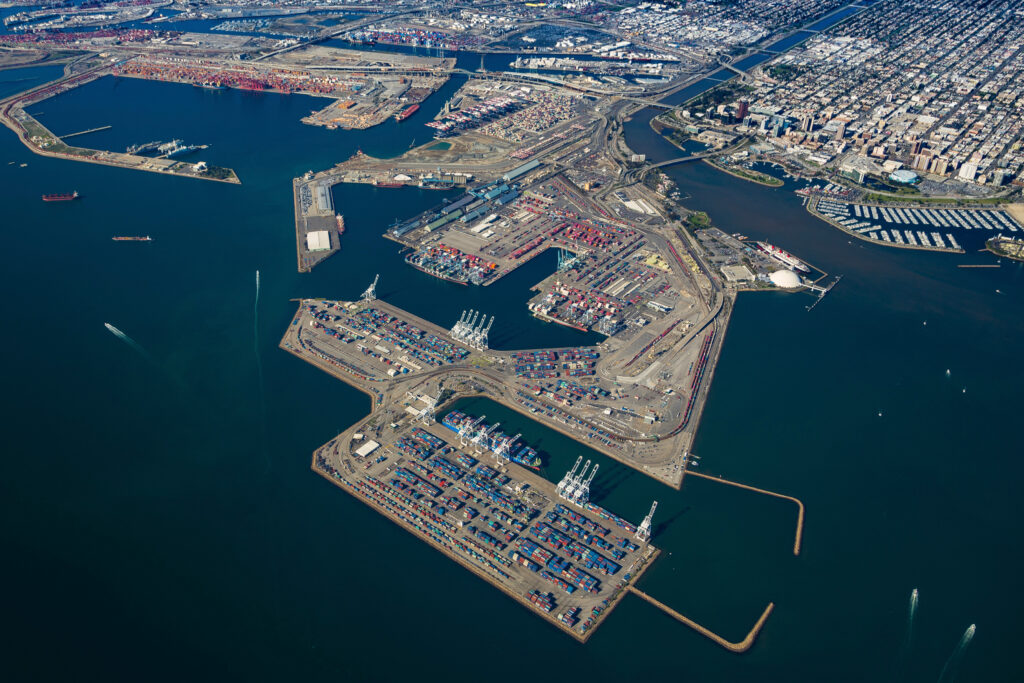
Automation is not a distant possibility, according to interviewees. Interviewees pointed to automated terminals at both the Port of Los Angeles and the Port of Long Beach. They described different technological configurations and different pathways through which terminals incorporated automated systems.
Long Beach Container Terminal (LBCT), for example, was rebuilt from the ground up around automated operations. Other terminals such as TRAPAC and APM Terminals, introduced automation into existing infrastructure.
The systems included automated guided vehicles, remotely operated cranes and computerised systems that coordinate the movement of equipment and containers. For interviewees, however, the question is less which machines are present than what happens to work when the machine can do more of it itself.
One interviewee described automation as a threat precisely because it can change the relationship between worker and machine: “I feel the automation is a threat to everybody. It’s just like a race to the bottom… automation… it’s going to come for real jobs. And not just in the long-shore industry. Not just in the warehouse industry. Yeah, but when you displace a large workforce, it’s impacting our society.”
Based on the same interviewee’s sentiments, a machine operating with minimal human intervention can become a substitute for that worker. In this sense, the distinction is central to how workers understand their own future.
Robots do not pay taxes
The concern about automation extends beyond the workplace. One worker put it bluntly: “Robots don’t pay taxes.” The remark is less about robotics than about how employment, households and port communities depend on one another.
Longshore work does not exist in isolation from the surrounding economy. Workers spend their wages in local businesses and support families. Their employment reaches well beyond the terminal gate.
From this perspective, replacing a worker with a machine does more than swap one occupational function for another. Interviewees saw it changing how income circulates through the community. They repeatedly connected automation to families, local businesses and community economic life. One longshore worker said: “But there needs to be a just transition in the sense of having labor. And also, the economic impact as well that protects it because you can’t displace all this work and then expect the city to thrive you know, like a lot of mom and pop shops. I go back home and I eat, I buy, I shop right. I give back to the community. I have friends and family that own shops. A lot of the economy will be impacted that way. And you can’t make up for all that loss of work and money.” Another interviewee said: “My father was a longshoreman. My cousin’s a longshoreman. My brother-in-law is a longshoreman. My best friends are longshoremen. This is the sort of community, particularly in San Pedro, Wilmington, also Long Beach, where the community lives off the economic activity that occurs in the port. And so we want to make sure that as we conduct this transition, these ports are economically vibrant because our communities depend on it.”
For these workers, the port is not merely a workplace. It is part of a wider social infrastructure. That observation is significant for ContainerHavens because port employment statistics can make the economic contribution of ports visible while obscuring the social relationships through which employment produces community life. A worker is not simply a unit of port labour. A worker is also a member of a household and a participant in a local economy.
Who gets the work created by automation?
Interviews did not describe automation only as destroying work; they also pointed to a potential redistribution of work.
Collective bargaining arrangements governing longshore work include provisions on technological change and the work that comes with new technologies. Interviewees expected new technology to create opportunities in maintenance, repair and skilled mechanical work. That raises a critical question: “When a machine replaces one task, where does the work associated with that machine go?”
A crane may become automated, but someone must still maintain it. An automated vehicle may move containers without a conventional driver, but someone must monitor, repair and manage the system. A remotely-operated machine may remove the need for a worker to sit in a cab, but it creates new requirements for control systems, software, maintenance, safety and technical supervision.
For workers, these are not merely technical details. As one interviewee put it: “Humans need to be involved in that. But everything in the middle can be automated. And so, it kind of like undermines this hierarchy that ILWU is very invested in, where you work your way up over 20 years of a career to get these really high paying specialized jobs.” This raises questions of occupational jurisdiction and recognition. Who has the right to perform the new work? Who is recognised as qualified to perform it? Is it covered by existing collective agreements? Can an employer assign it to a worker outside the bargaining unit? And what happens when the person controlling the machine is no longer physically at the terminal?
Beyond “automation versus jobs”
The San Pedro Bay interviews suggest that the familiar opposition between automation and employment is too narrow.
Four questions sit underneath it.
- a distributional question: Who gains and who loses when technology changes the organisation of work?
- a jurisdictional question: Who has the right to perform the new work created by technological transformation?
- a knowledge question: Whose knowledge counts when new technologies are designed and implemented?
- a recognition question: Who is still recognised as a port worker when the location and content of port work change?
These questions matter even more as the port pursues environmental goals. A zero-emission machine is not necessarily a zero-labour machine. A smart port is not necessarily a workerless port. A technologically advanced port does not have to make workers invisible. Political and institutional choices determine how these futures unfold.
A port future still made by people
Longshore work can be dangerous and workers know it. They also described strong attachments to their work, their colleagues and their union. They do not necessarily want the port to remain unchanged. They want to remain part of its future. As one union official stated: “we have to make sure that, you know, labor is represented. And as part of supervision, you know, we can if there’s no labor to do the job or no human beings, then we have nobody to supervise. So we have to make sure that labor is represented going towards the future.”
The future of the port is not only about what machines can do.
It is also about what societies decide that work should mean when machines can do more. On San Pedro Bay, workers are asking to be part of that decision. Not as opponents of technology. Not simply as beneficiaries of technological training. But as workers with knowledge, rights, communities and identities that are themselves being transformed by the technological future of the port. The question is not whether the port will become automated. It is this: when the port of the future arrives, who will still count as a port worker?
End notes
- [1] Edna Bonacich and Jake B Wilson, Getting the Goods – Port, Labour, and the Logistics Revolution (1st edn, Cornell University Press 2008) 178.
- [2] Deborah Cowen, The Deadly Life of Logistics: Mapping Violence in Global Trade (University of Minnesota Press 2014) 41 https://www.jstor.org/stable/10.5749/j.ctt7zw6vg accessed 15 January 2024.
- [3] Bonacich and Wilson (n 1) 178.
Learn more
- Learn more about the San Pedro Bay research site
- Follow ContainerHavens on LinkedIn for further updates
About the author

Peter Mbogo Kimani
PhD candidatePeter Mbogo Kimani is a PhD student in Law at the University of Antwerp (Belgium), and an Advocate of the High Court of Kenya. He holds a Bachelor of Laws (LL.B) from the University of Nairobi and two Master of Laws in International Trade, Investment and Business Law from Stellenbosch University (2022) and the University of the Western Cape (2025), South Africa. As part of the FWO ContainerHavens Project, his doctoral research focuses on how legal, spatial, and institutional frameworks share the identity and visibility of port workers, particularly in complex logistics hubs like Antwerp, San Pedro Bay Port Complex (Los Angeles and Long Beach), and Shanghai.
University of Antwerp
Faculty of Law and Institute of Development Policy (IOB)
Stadscampus – Gebouw V
Venusstraat 23
2000 Antwerp, Belgium
Research sites
Follow us
ContainerHavens 2026 | Disclaimer | Privacy policy | Cookie policy